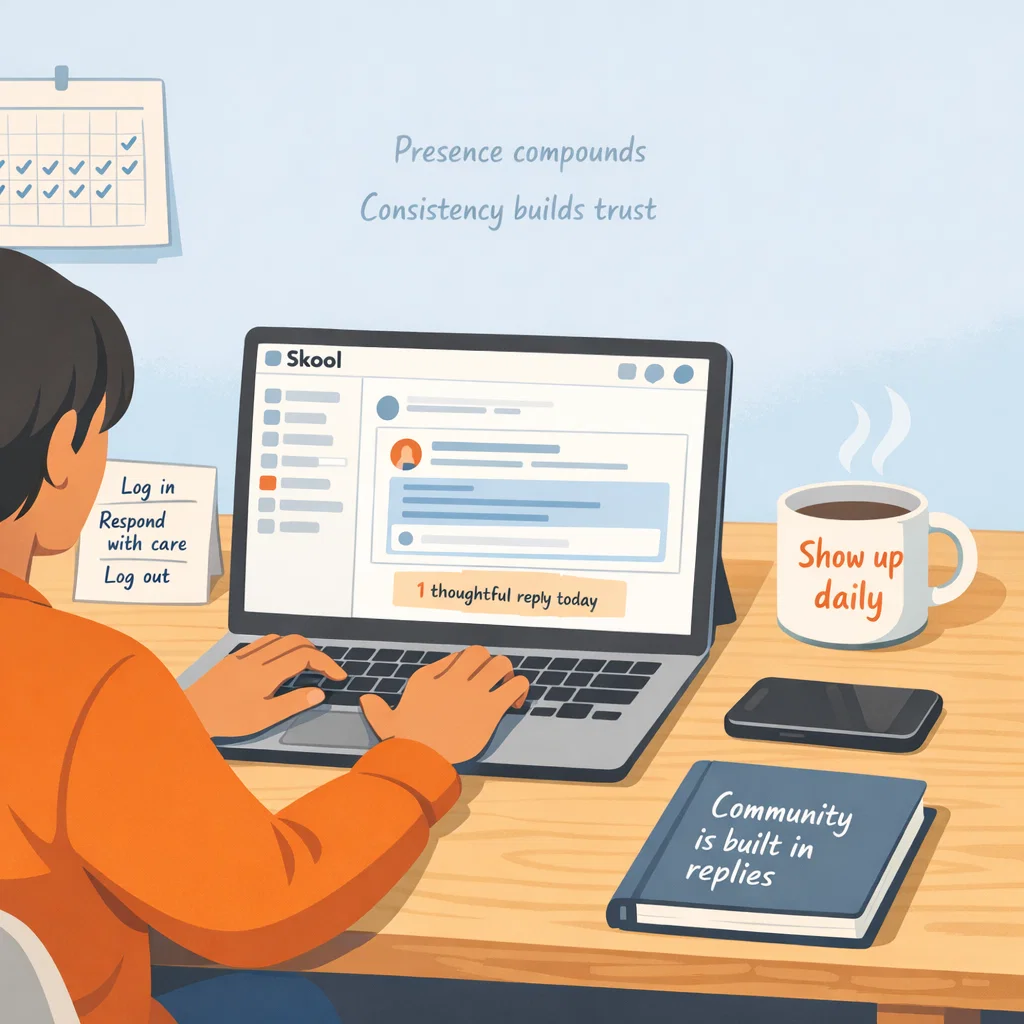
If your Skool community is not growing the way you expected, it is rarely because of the platform, the niche, or the pricing.
In most cases, it comes down to one thing: attention.
More specifically, consistent and intentional daily actions that compound over time.
After studying what actually moves the needle for Skool communities, one pattern shows up again and again. Not hacks. Not viral tricks. Just structured daily execution.
This article breaks down a simple but demanding framework for growing a Skool community through content, visibility, and relationships, without relying on ads.
Why Most Skool Communities Stall Early
Traffic is the real bottleneck for most community builders.
If you imagine your current setup with ten times more people seeing your content every day, the math becomes obvious. More visibility leads to more conversations, more joins, and eventually more revenue.
The problem is not knowing what to do. It is knowing where to focus and how much effort is actually required.
Growth at the beginning is not elegant. It is repetitive and uncomfortable. But it is predictable if done correctly.
A Simple Framework for Daily Growth
The idea is simple: stop spreading your effort across dozens of tactics and focus on three daily behaviors that reinforce each other.
Think in terms of time and consistency, not hacks.
The framework looks like this:
- Daily content creation
- Daily engagement with others
- Daily direct conversations
When these three are combined, growth becomes far more reliable.
Step One: Pick One Place and Commit
The biggest mistake beginners make is trying to be everywhere.
You do not need five platforms. One is enough.
Pick a single place where your audience already spends time. This can be:
- A social platform like Instagram, X, YouTube, LinkedIn, or TikTok
- Or a group based environment like Skool, Facebook groups, Reddit, or forums
If you are early, groups are often underrated. They require less algorithm luck and more human contribution. Visibility comes from participation, not performance.
Once you choose your place, commit. Do not switch every two weeks.
Step Two: Start With Engagement, Not Posting
If no one knows you yet, posting alone is slow.
Comments and replies get seen faster than standalone posts, especially early on.
Instead of publishing into silence:
- Engage with posts your audience already reads
- Respond thoughtfully
- Add context, examples, or clarity
Spending real time on replies instantly separates you from most people. Not because they are incapable, but because they are impatient.
Consistency here builds recognition before authority.
Step Three: Create One Valuable Piece of Content Per Day
Content does not need to be perfect. It needs to be useful.
One post per day is enough if it is intentional.
This could be:
- One Skool post
- One Instagram reel
- One YouTube video
- One thread or long form post
The goal is not volume for the sake of volume. The goal is to learn faster by publishing consistently.
Daily output shortens the feedback loop. You improve because you are exposed to reality more often.
Step Four: Make Your Profile Do the Work
When you show up consistently and add value, people will click your profile.
Your profile should answer three questions immediately:
- Who do you help
- What do you help them with
- Where should they go next
This is where your Skool link or free resource belongs. Not hidden. Not vague.
A clear profile quietly converts attention into members.
Step Five: Turn Attention Into Conversations
Most people stop once they post and comment.
That is where growth slows down.
Whenever someone engages with your content, they have shown interest. That is an opportunity to start a conversation, not a pitch.
Simple, human messages work best:
- Acknowledging their interaction
- Asking a relevant question
- Keeping it natural and short
After a few messages, invite them into your free community or resource if it genuinely fits.
This is relationship building, not automation.
Quality Beats Volume (The Important Adjustment)
Here is the part many people miss.
Doing things mechanically at scale can damage your reputation if the quality drops.
Instead of counting actions, focus on time spent intentionally.
That means:
- Spending focused time on comments, not rushing through them
- Having real conversations, not scripted outreach
- Creating content that actually saves people time or confusion
Reputation compounds just like traffic. Low effort actions compound too, just in the wrong direction.
What Makes Content Worth Paying Attention To
Good content does one thing well: it saves time.
If you learned something through experience, mistakes, or repetition, sharing that insight in a clear way creates value.
The strongest content usually comes from:
- Things you just tried
- Problems you just solved
- Conversations you just had
- Mistakes you just made
Stories work because they compress experience. People recognize themselves in them.
You do not need to be the most confident voice. You need to be the most useful one.
Growth Is Boring, Until It Isn’t
None of this is exciting at the start.
It is repetitive. It feels slow. It tests patience.
But consistency has a tipping point. Once people recognize your name, your comments, and your perspective, momentum builds quickly.
Most people quit before that point.
Final Thought
Growing a Skool community is not about secrets. It is about showing up daily with intention.
Focus on one place. Add real value. Build relationships. Repeat.
That is how attention compounds.
Want Help Applying This Calmly and Correctly?
If you are building a Skool community and want structure, clarity, and realistic guidance without hype, this is exactly what we work on inside the Filiato community.
Filiato is a focused space for builders who want sustainable growth, clear systems, and long term thinking before scaling tools or tactics.
You can join the community and start building with intention instead of guessing.