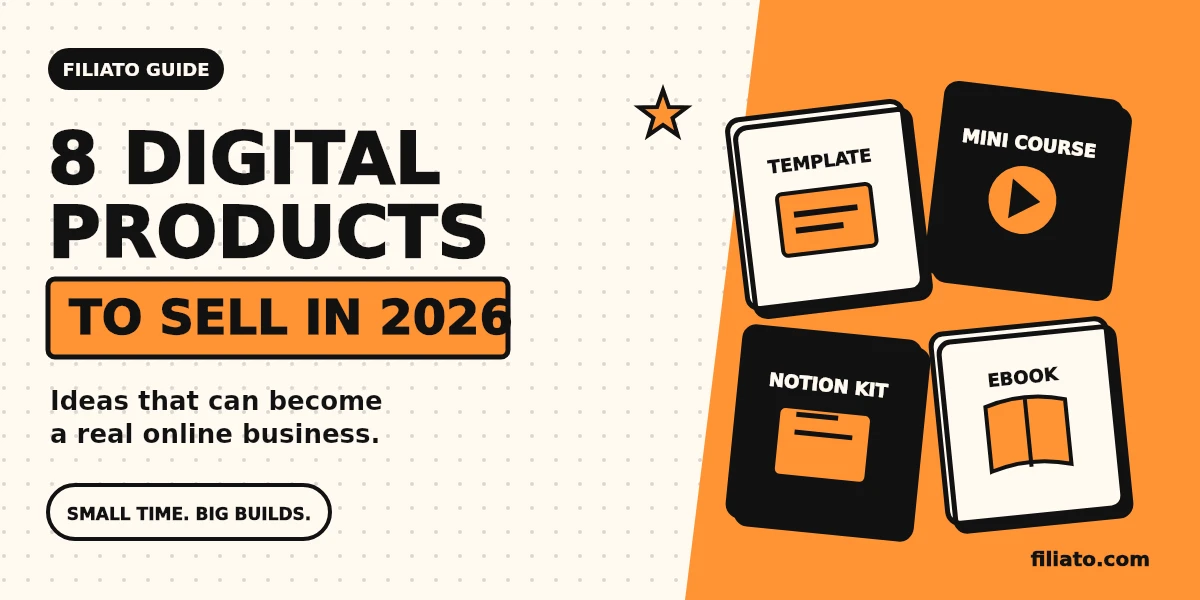
Digital products are not dead. Generic digital products are.
It has never been easier to make a template, a PDF, a prompt list, or a small app. That is good news for creators, but it also means buyers have far more choice and far less patience. A product that feels copied, broad, or unfinished is easy to ignore.
The products that stand out in 2026 are useful in a very specific way. They help a recognisable person solve a frustrating problem faster. They show proof before asking for money, and they give the buyer a reason to return through updates, accountability, community, or a next step.
This guide breaks down the most practical digital product opportunities, the trade-offs behind each one, and a simple way to choose your first product without building something nobody wants.
What makes a digital product worth buying now?
People rarely pay for a file simply because it contains information. Information is abundant. They pay for a shortcut, a clearer decision, a ready-made workflow, or support that helps them follow through.
That is why a broad “productivity template” often struggles while a client onboarding system for freelance video editors can feel valuable immediately. The second product tells the buyer, “This was made for my situation.”
Before choosing a format, pressure-test the idea against four questions:
- Who is it for? Name one type of person, not everyone.
- What job does it help them do? Focus on a repeated frustration or desired outcome.
- Why would they not make it themselves? Your product should save time, reduce uncertainty, or provide a better result.
- How will they discover it? A product and a distribution plan need to be built together.
A useful starting sentence is: “[Specific person] struggles with [specific problem] and currently handles it by [awkward workaround].” If you cannot describe the workaround, spend more time talking to potential buyers before you start building.
1. Niche templates and ready-to-use systems
Templates remain one of the best starting points for new creators because they are fast to validate and easy for buyers to understand. This category includes Notion workspaces, Canva kits, Google Sheets trackers, Airtable bases, client portals, checklists, and standard operating procedure libraries.
Why templates sell
A well-made template removes setup work. The buyer is not paying for a few pages in Notion or a spreadsheet full of formulas. They are paying to avoid hours of figuring out what to include, how to organise it, and what to do next.
The strongest templates are tied to a real workflow. For example:
- A content calendar for local real estate agents
- A proposal and onboarding kit for freelance web designers
- A cash-flow tracker for freelancers with irregular income
- A job-application dashboard for international candidates moving to the Netherlands
How to make yours more valuable
Do not sell an empty dashboard. Include a short setup video, a filled-in example, clear instructions, and a small “first 30 minutes” checklist. Those additions reduce the chance that a customer opens the product, feels overwhelmed, and never uses it.
Single templates commonly work as lower-priced entry products. More complete operating systems, especially those for businesses, can justify a higher price because the outcome is more valuable. Price around the time, mistakes, or stress your buyer avoids, not around the number of hours you spent designing it.
2. Printables and planners with a clear point of view
Printable planners, trackers, invitations, wall art, worksheets, and activity packs can still work, particularly when they are visually strong and made for one occasion, life stage, or style preference.
The challenge is that generic listings are everywhere. “Weekly planner” is a crowded product. “Postpartum meal-prep planner for busy new parents” gives someone a much clearer reason to click.
How to compete without racing to the bottom
- Build a consistent collection instead of unrelated one-off listings.
- Use strong product previews that show the pages in context.
- Create for a specific use case, season, audience, or aesthetic.
- Bundle complementary items so the purchase feels complete.
- Use Pinterest and short demonstrations to show how the product fits into real life.
If you sell through Etsy, understand its rules before publishing. Etsy states that digital items must be made and/or designed by the seller. It allows seller-prompted creations made with generative tools when their use is disclosed in the listing description, and it does not allow prompt bundles as standalone listings. Read Etsy’s current digital-item guidance and policy explanation before relying on an old marketplace tip.
3. Short, practical ebooks and niche guides
A useful guide does not need to be long. It needs to help someone make progress. The best digital guides are usually narrow, practical, and supported by examples, checklists, templates, or a clear action plan.
A generic ebook about “making money online” has to compete with countless free articles and videos. A guide on how a freelance photographer can turn one client shoot into a monthly content package has a clearer job and a more specific buyer.
What readers will pay for
Buyers are increasingly good at noticing recycled content. A guide needs more than a collection of obvious tips. Add original judgment: your process, a concrete framework, annotated examples, decision criteria, mistakes to avoid, and tools that make the process easier.
One practical approach is to combine a compact guide with a working asset. For example, a guide about creating a service offer could include a pricing worksheet, a discovery-call script, and a proposal outline. The guide explains the thinking; the assets help the reader act.
4. Courses that create momentum, not just a video library
Courses can be excellent products, but they are the wrong first choice for many new creators. They take longer to make, require more trust from the buyer, and can become a large collection of videos that people never finish.
The better question is not “What course can I create?” It is “What result can I help a small group achieve in the next four to six weeks?”
A stronger course model
Instead of recording forty lessons before you have a single customer, begin with a small challenge, workshop series, or cohort. Give participants a start date, weekly milestones, check-in prompts, and a place to ask questions. You can record and improve the material as you learn where they get stuck.
This format creates accountability and gives you much better feedback than selling a static library. It also creates proof: participant progress, questions, and testimonials can show future buyers what the program actually helps people do.
A self-paced mini-course can still be a good entry product when the outcome is tight. Think “Set up your first client onboarding workflow this weekend,” not “Everything you need to know about freelancing.”
5. Communities and memberships
A membership makes sense when the ongoing value is real. That can be feedback, regular live sessions, fresh opportunities, peer accountability, updated resources, or a clear path towards a result. “Access to a community” on its own is rarely enough.
For example, a community for new freelance designers could centre on landing their first three retainer clients. Weekly portfolio feedback, outreach reviews, lead-sharing, and monthly challenges all reinforce that transformation. A broad “freelancers community” offers much less clarity.
Start with trust
Most people will not pay recurring fees from a cold audience. A free community, short workshop, newsletter, or public content series can provide the proof of value first. Once people know what you help them achieve, a focused paid tier becomes far easier to explain.
Be honest about the work involved. Communities are not passive income. They need moderation, welcoming new members, useful prompts, and consistent energy. If you enjoy helping people make progress, the recurring relationship can be much more rewarding than selling a one-time file.
6. Profession-specific workflows and prompt-supported systems
A list of generic prompts is no longer compelling. Anyone can ask a chatbot for a page of prompts in a few minutes. What still has value is a system that helps a specific professional complete a real task with better context, examples, and quality checks.
For instance, instead of selling “100 marketing prompts,” build a content-production system for independent coffee shops: briefing questions, prompt templates, example outputs, a monthly calendar, an approval workflow, and a checklist for keeping the brand voice consistent.
The prompts are only one component. The buyer is paying for the workflow, the choices you have already made, and the examples that help them avoid weak output.
7. Micro-tools and focused subscription software
Small software tools are more accessible to create than they once were, but software is not an easy shortcut. Building the first version is only the beginning. You still need a real problem, users willing to pay, reliable support, and a way to reach customers.
The best opportunity is a narrow, repeated task. Think of a tool that prepares a client-ready report from a fixed data source, generates compliant product labels from entered specifications, or organises incoming leads for one type of service business.
Start smaller than you think
Before creating an app, try to solve the task manually for a few people with a spreadsheet, a template, or a concierge service. If they use it, ask for it again, and are prepared to pay, you have evidence worth building on. If not, you have saved yourself months of development.
For software that provides ongoing value, a straightforward subscription can make more sense than a one-time sale. Keep the offer simple, make the result obvious, and avoid turning a useful tool into an overbuilt platform.
8. Private-label content as a starting point, not a finished product
Private-label rights content can save research and production time, but it is not a business model by itself. Buyers quickly recognise a product that has been rebranded without being meaningfully improved.
Use licensed material as raw input only. Rewrite it for one audience, update outdated advice, add your own examples, redesign the presentation, and package it with an original template or implementation guide. Always check the specific licence carefully, especially for resale, editing, attribution, and marketplace use.
The mistakes that stop good ideas from selling
| Common mistake | Why it hurts | A better move |
|---|---|---|
| Creating for everyone | The product feels interchangeable and competes mainly on price. | Name one buyer and one problem in the offer. |
| Building before validating | You can spend weeks polishing something nobody asked for. | Share a simple preview, waitlist, free version, or paid beta first. |
| Selling information without implementation | Buyers can find broad advice everywhere. | Add examples, tools, decision rules, and a realistic next action. |
| Launching without distribution | Even useful products disappear when no one sees them. | Choose one channel and build audience trust alongside the product. |
| Copying licensed content as-is | It looks generic and creates trust and licensing risks. | Use it only as a base for a distinctly better, niche-specific product. |
A simple build-and-launch plan
Step 1: Choose one audience you can understand
You do not need to be the world’s leading expert. You do need enough proximity to understand the language, bottlenecks, and desired outcomes of the people you want to help. Your work experience, hobbies, and communities are often better starting points than a trending niche you barely know.
Step 2: Pick the lightest useful format
Do not build a course when a worksheet solves the problem. Do not build software when a done-for-you spreadsheet proves the demand. Start with the smallest format that can produce a useful result.
Step 3: Create a free proof-of-value asset
Offer a simplified template, a checklist, a small workshop, or a useful email series. This gives people a low-risk way to see your approach, helps you collect feedback, and begins building an audience you can serve again.
Step 4: Make the paid version complete
Your paid offer should not simply be “more pages.” It should make the outcome easier. Add worked examples, implementation help, community access, updates, or personal feedback when those elements directly support the promise.
Step 5: Pick one distribution channel
Choose the channel that suits how your product is discovered. Visual planners can work well with Pinterest. Templates and tools are ideal for short product demonstrations. Business systems can be introduced through helpful YouTube content, a newsletter, or niche communities where the problem is already being discussed.
Step 6: Improve from real customer behaviour
Watch where people hesitate, what questions they ask, and what they actually use. Those signals should shape your next version, your sales page, and the next product in the line.
Digital product price ranges to use as a starting point
There is no universal correct price. Your audience, proof, positioning, support level, and the value of the outcome matter more than any price chart. Still, these ranges can help you avoid starting without a reference point:
- Single printable or simple template: roughly $3 to $15
- Template bundle or operating system: roughly $29 to $149
- Focused guide with a practical asset: roughly $15 to $50
- Short self-paced course: roughly $29 to $149
- Live challenge or small cohort: roughly $97 to $497
- Entry-level membership: roughly $9 to $49 per month
- Focused micro-tool: roughly $9 to $29 per month
Use these as hypotheses, not promises. A $12 template that saves a business owner two hours can be a better offer than a $99 course with no obvious outcome. Test your positioning and price with real buyers, then adjust based on demand and support required.
Final thought: build a product line, not isolated downloads
The first product is rarely the entire business. A useful niche template can lead to a more complete toolkit. The toolkit can lead to a workshop, a community, a service, or a lightweight tool. Each step becomes easier because you know the same audience better.
Start narrow. Solve one problem well. Show the result. Then build the next logical step for the people who already trust you.
That is how a digital product stops being another download and starts becoming a real business.
Ready to choose a direction? Explore the free resources and starter kits on Filiato, or join the conversation at the Filiato community.
Editorial note: Marketplace policies and platform features can change. Confirm current rules directly with each platform before you publish or sell.