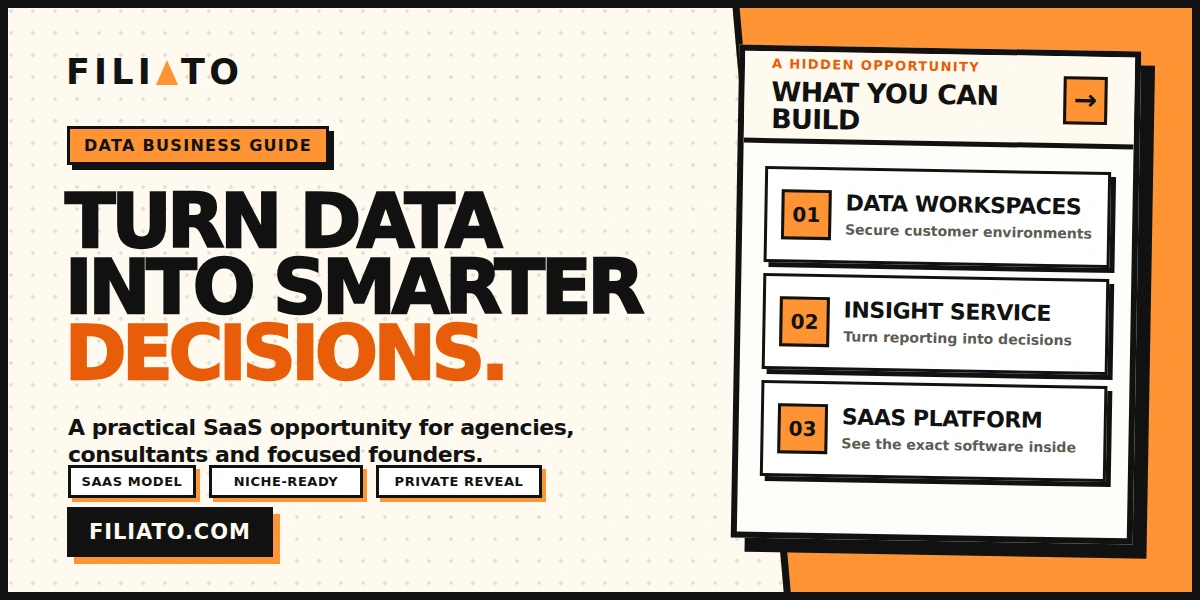
AI Data Analysis SaaS Opportunity Most Founders Overlook
Businesses collect sales, marketing and operational data every day. The difficult part is turning scattered information into a clear decision without hiring a full analytics team. This guide explores a platform model built around that gap, and the software foundation behind it stays protected until the end.
- SaaS concept
- Target customers
- Offer angles
- Technical reality
- Launch checklist
Sell clearer decisions, not more dashboards
Small teams often have reports, spreadsheets and connected tools, yet still struggle to answer simple questions: Which campaign is working? Where is revenue leaking? What changed this month? A focused data-analysis service can make those questions easier to investigate in one place.
What is a data analysis platform business?
A data analysis platform brings data work, source connections and user access into a managed environment. Instead of offering broad business intelligence to everyone, you can package a narrow outcome for a specific audience, such as marketing clarity for local agencies or performance reporting for ecommerce stores.
Platform access
Give users a secure workspace where they can manage their data and review results relevant to their role.
Done-with-you setup
Charge for source mapping, account configuration, data preparation and reporting logic before the subscription begins.
Recurring service
Retain clients through monitoring, report interpretation, custom requests and ongoing improvements.
Why useful data is still hard to use
The problem is rarely a lack of numbers. It is fragmentation, inconsistent reporting and the time needed to investigate changes. These are the conversations that can create demand for a focused analysis offer.
Reports live everywhere
Sales, ad spend, customer activity and operational information sit across separate files and systems.
Teams react too late
When reporting takes days to assemble, a campaign, product or process issue can continue unnoticed.
Leadership needs plain answers
Decision-makers need context and priorities, not a large collection of unexplained charts.
Start with customers who already have meaningful data
Choose a niche with repeatable information, decisions that happen regularly and a clear cost when the team is slow to spot a problem. You do not need to serve every industry to validate the offer.
| Customer type | Useful question | Possible offer |
|---|---|---|
| Marketing agencies | Which campaigns deserve more budget? | Client-ready performance reporting workspace |
| Ecommerce brands | What is affecting conversion, repeat purchase or margin? | Weekly commercial insight and action review |
| Sales-led B2B teams | Where are opportunities slowing down? | Pipeline health and source-quality reporting |
| Multi-location operators | Which location needs attention first? | Location comparison and operating review |
| Research firms | How can findings be shared securely with clients? | Branded research workspace and managed access |
Three ways to package the same foundation
The platform is only the starting point. Your commercial offer should make its intended result, support level and data boundaries clear.
Insight Sprint
- Map a defined business question
- Connect agreed sources
- Create a decision-ready report
- Present findings and next actions
Managed Reporting
- Recurring workspace access
- Scheduled analysis and reporting
- Monthly decision review
- Defined support and changes
Niche Data Portal
- Branded customer accounts
- Repeatable niche templates
- Subscription plans and billing
- Optional implementation service
The capabilities a serious platform needs
Before choosing a script or building from scratch, check whether the foundation supports the business you want to run. The solution reviewed for this guide includes the core administrative and customer-management layers needed for this type of model.
Workspace and data control
Separate customer environments and data-source management make a multi-client service more practical to operate.
Billing and access
Plans, subscriptions, transaction records and payment options are essential if customers will pay for continuing access.
Operational administration
Admin controls, support tickets, notifications, language settings and policy tools matter once the first users arrive.
Self-hosted gives you control and responsibility
The software behind this guide is a Laravel application for PHP 8.x environments. That can be useful if you need control over the deployment and platform configuration, but it also means you need appropriate hosting, backups, updates and someone accountable for the technical side.
Plan for
- A suitable server and secure deployment
- Database, email and scheduled-task configuration
- Backups, access management and updates
- Testing before customer data is connected
Verify before launch
- The required data sources and provider integrations
- Current usage or third-party service costs
- Your privacy, retention and access practices
- The licence that matches your exact commercial model
A practical way to test demand first
Validate one narrow use case before you invest time in building a broad platform. The goal is to find a customer who values a better decision process, not to activate every available setting.
- Choose a nichePick one audience and one recurring decision problem.
- Talk to buyersAsk how they collect data, what is slow and what decisions are delayed.
- Build a limited demoUse sample or approved data to show one useful workflow.
- Sell a pilotDefine setup, scope, ownership, support and a clear review date.
Questions before revealing the platform
Can this become a SaaS business?
It can provide a foundation for a subscription-based data service, but the licence, hosting, provider costs, privacy setup, customer support and product strategy still need to fit your exact model.
Do I need to be a data scientist?
Not necessarily. You do need to understand the customer’s business question, data quality limits and how to explain findings responsibly. Complex use cases may require specialist support.
Can I use it for several customers?
The platform includes workspace and user-management features. Confirm the current licence and your intended use before onboarding clients or charging end users.
What should I ask during a demo?
Check the actual source-connection flow, workspace separation, plan and payment behaviour, reporting experience, documentation and how updates are handled.
How do I reveal the software?
Use the protected section below. It will reveal the product name, purchase source, current licensing options and the evaluation points to check before you buy.
See the platform behind this data-business model
Unlock the protected section to reveal the software name, purchase source, current licence options, the included platform areas and the specific questions to ask before you build on it.
Ready to see the exact platform?
Always review the live demo, current documentation and licence terms before purchasing.Educational information only. Platform capabilities, pricing, support and licensing can change. Verify the live listing, technical requirements, privacy obligations and commercial licence before purchasing or launching a customer-facing service.
Unlock the complete resource
Enter your email to instantly unlock the protected content below.