Creating a successful product listing involves much more than writing a short title and adding a few product photos. Sellers must understand what customers are searching for, choose relevant keywords, describe the product clearly and adapt the content to the requirements of each marketplace.
This process becomes even more complicated when the same product is sold on Etsy, Amazon, eBay and other ecommerce platforms. Every marketplace has its own title limits, category structure and listing requirements.
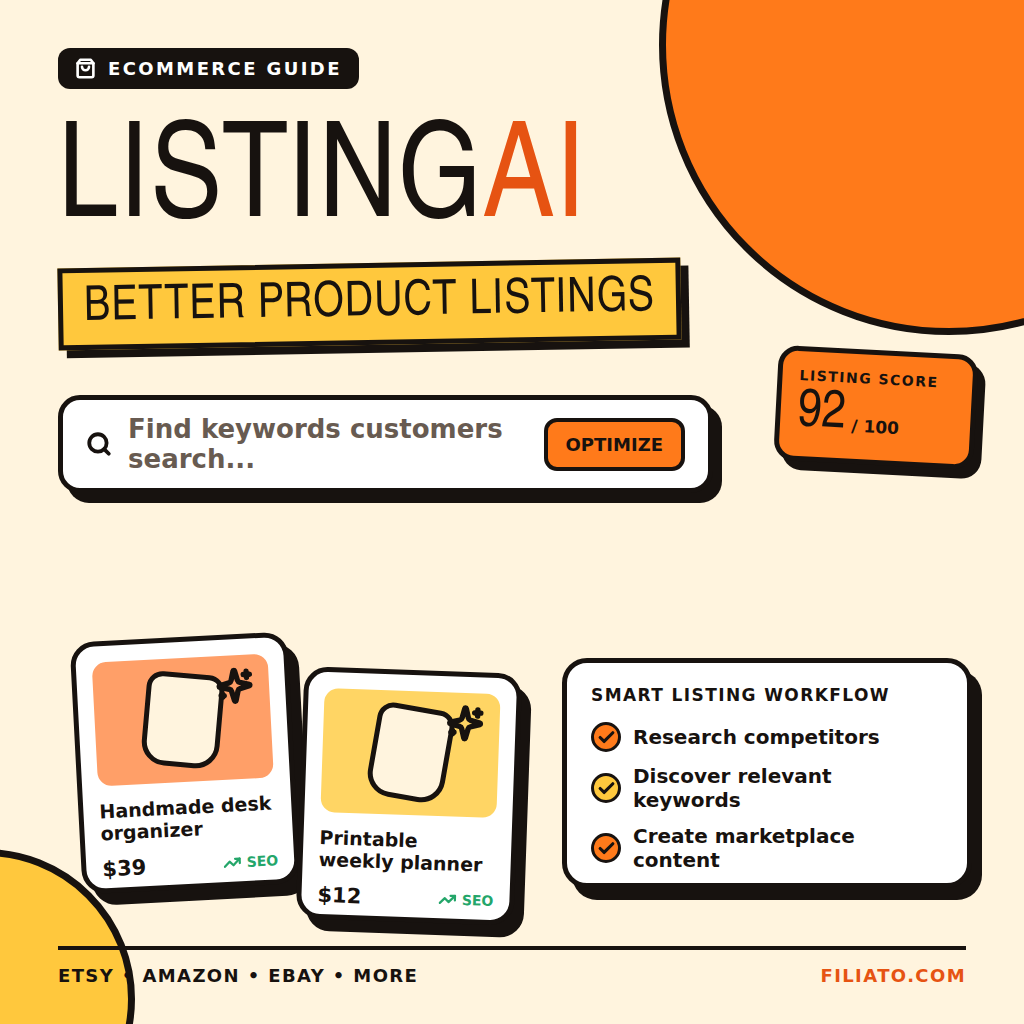
ListingAI is designed to simplify this process. It combines product listing generation with Etsy market research, competitor analysis, keyword suggestions and optimization tools. Sellers can use the platform to create listings for multiple marketplaces while reducing the amount of manual research and writing required.
This guide explains what ListingAI is, who it is designed for, how sellers can benefit from it and how it can be used in practical ecommerce situations.
What Is ListingAI?
ListingAI is a product listing creation and optimization platform for ecommerce sellers. It helps users research successful Etsy listings and generate product content for Etsy, Amazon, eBay, Walmart and several other marketplaces.
Unlike a basic writing tool that only creates a description from a short prompt, ListingAI is designed to incorporate information from live Etsy market data. According to the product information, the software can examine elements such as competitor prices, popular tags, title structures and category patterns before generating a new listing.
The objective is to give sellers a more informed starting point. Instead of writing a listing without knowing what already performs well in the market, users can study relevant competitors and use those insights when preparing their own content.
ListingAI can help generate several important parts of a product listing, including the title, description, tags, keywords and category information. It also provides an SEO score that can help users identify whether a listing contains the main optimization elements expected by the platform.
The software currently supports 15 marketplaces. These include Etsy, Amazon in the United States, United Kingdom, Germany, France, Spain, Italy, Japan, Canada and Australia, as well as eBay, Walmart, Kaufland, Ozon and Joom.
It also supports 17 languages, including English, German, French, Spanish, Italian, Turkish, Dutch, Polish, Portuguese, Swedish, Danish, Norwegian, Finnish, Czech, Romanian, Hungarian and Russian.
This makes ListingAI potentially useful for sellers who want to expand into different countries without creating every listing from the beginning.
How Does ListingAI Work?
The general workflow begins with information about the product. The seller provides details such as the product type, materials, features, target customer, style, intended use and any important benefits.
ListingAI then uses this information together with its available market data to prepare an optimized listing for the selected marketplace.
A typical workflow may look like this:
- Select the marketplace where the product will be published.
- Enter the main product information.
- Choose the preferred language.
- Examine competitor listings and relevant keyword information.
- Generate the product title, description and tags.
- Review the SEO score and suggested improvements.
- Edit the content to ensure that every claim is accurate.
- Copy the content to the marketplace or send it to Etsy as a draft if direct publishing is available on the selected plan.
The generated listing should be treated as a strong first draft. Sellers still need to check product specifications, measurements, delivery details, legal claims and marketplace policies before publishing.
Who Is ListingAI For?
ListingAI is primarily designed for people who sell physical or digital products through online marketplaces.
Etsy Sellers
Etsy sellers are one of the main groups that could benefit from ListingAI. The platform focuses heavily on Etsy market data, competitor prices, popular tags and successful title patterns.
This can be useful for handmade product sellers, digital product creators, print on demand businesses, vintage sellers and craft supply shops.
A seller offering printable wedding invitations, for example, could use ListingAI to study the wording and tags commonly found in successful listings within that category. The seller could then generate a listing that is better aligned with customer search behavior.
Amazon Sellers
Amazon sellers can use ListingAI to prepare product titles and descriptions for several regional Amazon marketplaces.
This may be helpful for small brands that want to list the same product in the United States, United Kingdom and European markets. The ability to generate content in multiple languages can reduce the time required to prepare an initial version for each country.
However, Amazon sellers should still perform Amazon specific keyword research. Etsy search behavior and Amazon search behavior are not always the same.
Multichannel Ecommerce Businesses
Businesses that sell the same products across several marketplaces often spend significant time rewriting and reformatting their listings.
ListingAI can help create platform specific versions of the same core product information. A handmade leather wallet, for example, can be presented differently on Etsy, Amazon and eBay while maintaining consistent specifications and brand messaging.
Print on Demand Sellers
Print on demand sellers frequently launch multiple products based on similar designs. Writing individual titles, descriptions and tags for every shirt, mug, poster or tote bag can become repetitive.
ListingAI can help create a structured first draft for each product variation. Sellers can then personalize the content to match the design, audience and occasion.
Digital Product Creators
Creators who sell templates, planners, ebooks, presets, spreadsheets or printable materials can use ListingAI to improve how their products are presented.
The tool may help them describe what the customer receives, explain how the product can be used and identify relevant search terms.
Ecommerce Agencies and Virtual Assistants
Agencies and freelancers who manage listings for clients can also use ListingAI as part of their workflow.
Instead of spending most of their time writing first drafts, they can focus on competitor research, positioning, editing, image quality and conversion optimization.
ListingAI may be especially useful for virtual assistants responsible for uploading large numbers of products to ecommerce stores.
Sellers Expanding Into New Markets
The support for multiple languages can help businesses prepare listings for international marketplaces.
It is important to remember that translation alone is not localization. Product terminology, measurements, cultural preferences and buying behavior can vary between countries. Every translated listing should therefore be reviewed by someone familiar with the target market.
How to Benefit the Most From ListingAI
ListingAI can save time, but the quality of the final result still depends on the information provided by the seller and the way the generated content is used.
Start With Complete Product Information
Before generating a listing, collect all the important product details.
Include the product type, materials, dimensions, colors, intended use, target customer, care instructions, delivery format and any important limitations.
For a digital planner, explain whether the customer receives a PDF, an editable Canva template or another file format. Mention the page size, number of pages and whether the product is designed for printing or digital use.
The more specific the input is, the easier it becomes to generate a useful and accurate listing.
Research the Customer Before Researching Keywords
Keywords are valuable only when they reflect the way real customers describe the product.
Think about who is buying the item, why they need it and what problem they are trying to solve.
A customer may not search for a general phrase such as “business template.” They may search for “social media planner for small business” or “Canva content calendar for Instagram.”
Understanding search intent helps sellers choose more specific and commercially relevant phrases.
Use Competitor Data for Direction
Competitor information should be used to understand the market, not to copy another seller.
Look for repeated ideas across several successful listings. Pay attention to common product benefits, customer language, price ranges, title structures and recurring tags.
If several successful listings mention that a product is suitable for a particular occasion or audience, that may reveal an important customer need.
The goal is to understand why customers respond to certain listings and then communicate the unique value of your own product.
Generate Separate Content for Each Marketplace
Avoid using exactly the same title and description everywhere.
Etsy customers may respond to style, occasion, personalization and craftsmanship. Amazon customers may prioritize product specifications, compatibility and practical benefits. eBay buyers may focus more heavily on condition, availability and delivery.
ListingAI supports marketplace specific rules, so sellers should generate an appropriate version for each platform.
Review Every Generated Claim
Never publish generated content without checking it.
Confirm that the listing does not invent materials, dimensions, certifications, guarantees or product benefits. Remove any statement that cannot be verified.
This is especially important for products involving health, cosmetics, food, children, safety or regulated claims.
Improve the Listing With Brand Personality
Optimization helps a product become discoverable, but brand personality helps it become memorable.
Add details about how the product was created, what inspired it, who it is designed for and what makes it different from similar alternatives.
A listing should sound natural and trustworthy. Repeating keywords too often can make the content difficult to read and may reduce buyer confidence.
Measure Results Over Time
Do not judge a listing only by its SEO score.
Monitor impressions, clicks, saves, conversion rate and sales. If a listing receives impressions but very few clicks, the main image, price or title may need improvement. If it receives clicks but few sales, the description, product photos, reviews, delivery information or offer may be the problem.
Listing optimization should be treated as an ongoing process rather than a one time task.
Examples of How ListingAI Can Be Used
Example 1: Creating an Etsy Listing for a Digital Planner
Imagine that a creator wants to sell a printable weekly planner on Etsy.
The creator can enter information about the planner, including the file type, page size, number of pages, design style and intended customer.
ListingAI can help identify related search terms and generate a title, product description and collection of tags.
The creator should then personalize the description by explaining exactly what is included, how the files are delivered, how customers can print them and whether refunds are available for digital products.
Example 2: Adapting a Product for Etsy and Amazon
A small business sells handmade wooden desk organizers.
For Etsy, the listing may emphasize craftsmanship, wood type, personalization and gifting occasions.
For Amazon, the listing may focus more on dimensions, storage capacity, desk compatibility and practical benefits.
ListingAI can help generate separate versions while the seller maintains consistent specifications across both marketplaces.
Example 3: Preparing Listings for Different Countries
A print on demand seller wants to offer motivational wall art in several European markets.
The seller can generate listings in English, German, French, Spanish and Italian. Each version can then be checked by a native speaker or professional translator.
The final listings should also use the appropriate measurements, spelling conventions and customer terminology for each market.
Example 4: Updating an Underperforming Etsy Listing
An Etsy seller has a product that receives very few visits.
The seller can use ListingAI to examine competitor titles, tags, pricing patterns and category information. The existing listing can then be rewritten with clearer search terms and a stronger explanation of the product.
After making the changes, the seller can monitor impressions and clicks to determine whether the new version performs better.
Example 5: Launching a Collection of Related Products
A print on demand business is launching ten shirts based on different hobbies.
Instead of writing all ten listings manually, the seller can create a detailed product information template and use ListingAI to generate a separate listing for each design.
The seller should still edit every listing so that it reflects the specific hobby, customer and occasion. This prevents the shop from appearing repetitive.
Example 6: Supporting Client Work
A virtual assistant manages Etsy listings for several small businesses.
The assistant can use ListingAI to prepare first drafts, research competitor patterns and organize relevant tags. More time can then be spent checking accuracy, editing the writing and improving the overall presentation.
This can make the listing service more efficient without removing the need for professional judgment.
Pros of ListingAI
Access to Live Etsy Market Data
One of the most notable features is the use of live Etsy data. The platform is designed to examine competitor prices, tags and successful listing patterns before generating content.
This may provide a more relevant starting point than a general writing tool with no marketplace context.
Support for Multiple Marketplaces
ListingAI supports 15 marketplace variations from one platform. This can be valuable for sellers who want to expand beyond Etsy or manage products across several sales channels.
Support for Multiple Languages
The availability of 17 languages can help sellers prepare the first version of an international listing more quickly.
Platform Specific Formatting
Different marketplaces have different rules for titles, tags and categories. ListingAI is designed to adapt the generated content to the selected platform.
Competitor Analysis
Sellers can use competitor information to understand pricing, positioning and keyword patterns in their niche.
SEO Scoring
An SEO score can provide a quick indication of whether the listing includes important optimization elements. It can also help newer sellers follow a more consistent process.
Direct Etsy Draft Publishing
According to the current product information, Pro users can connect their Etsy account and send generated listings directly to the shop as drafts.
Publishing as a draft gives the seller an opportunity to check the content before making the listing visible.
Saved Listing History
Saved history can make it easier to revisit previous listings, compare versions and maintain a more organized content workflow.
Cons of ListingAI
It Is an Early Stage Product
ListingAI is currently presented through AppSumo Radar, which is intended for early stage software.
Early stage tools may change quickly. Features may evolve, technical issues may occur and the product may not yet have the same level of stability as an established ecommerce platform.
Limited Independent User Feedback
At the time this guide was prepared, the AppSumo page did not display public customer reviews.
This means potential users have limited independent information about long term reliability, support quality and real world results.
Etsy Data May Not Represent Every Marketplace
Live Etsy data can be helpful for Etsy sellers. However, customer behavior on Etsy may differ from customer behavior on Amazon, Walmart, eBay or other marketplaces.
Sellers using ListingAI outside Etsy should combine it with marketplace specific research.
Generated Content Still Requires Editing
The software can accelerate research and writing, but it cannot verify every product detail automatically.
Sellers must review the final content for accuracy, brand voice, readability and compliance.
Localization Requires Human Review
Generating content in another language is useful, but it does not guarantee that every phrase will sound natural to local buyers.
International listings should be reviewed for language quality, measurements, cultural context and regional marketplace rules.
Direct Publishing Is Focused on Etsy
The direct publishing feature currently applies to Etsy drafts. Sellers using other marketplaces may still need to transfer and publish the generated content manually.
Optimization Does Not Guarantee Sales
No product listing tool can guarantee rankings or revenue.
Search visibility and sales can also be influenced by product demand, competition, pricing, photography, reviews, delivery costs, customer service and the history of the seller’s account.
Important Considerations Before Using ListingAI
Before choosing any listing optimization platform, think about your current workflow.
If you publish only a few products and already have a reliable research process, a dedicated platform may not dramatically change your business.
If you regularly create listings, sell on multiple marketplaces or spend many hours researching keywords and writing descriptions, ListingAI may provide more practical value.
Potential users should also examine the current plan details carefully. Software features, prices and usage limits can change. Confirm which plan includes direct Etsy publishing, competitor analysis, monthly listing limits and future updates before purchasing.
Because ListingAI is an early stage product, it is also sensible to test its output with a small collection of products before using it across an entire store.
Frequently Asked Questions About ListingAI
Does ListingAI Work Only With Etsy?
No. ListingAI supports Etsy, multiple regional Amazon marketplaces, eBay, Walmart, Kaufland, Ozon and Joom.
Its live market research feature is focused on Etsy data, so additional research may be necessary when targeting other platforms.
Can ListingAI Publish Products Directly to Etsy?
According to the current product information, Pro users can connect an Etsy account and send generated listings to the shop as drafts.
The seller can review the draft before publishing it.
Do I Need to Connect My Etsy Account?
An Etsy account connection is not required for generating or analyzing listings.
The connection is needed only if the seller wants to send listings directly to an Etsy shop.
Can ListingAI Translate Product Listings?
ListingAI supports 17 languages. The generated translation should still be reviewed for accuracy and natural local terminology.
Is ListingAI Suitable for Digital Products?
Yes. It can be used for printable planners, templates, ebooks, design files, presets, digital art and other downloadable products.
The seller must provide clear information about file formats, delivery, compatibility and usage rights.
Can ListingAI Guarantee Better Etsy Rankings?
No. The platform may help sellers create more structured and relevant listings, but rankings cannot be guaranteed.
Marketplace algorithms consider many factors, including relevance, conversion history, customer experience, competition and product demand.
Final Thoughts
ListingAI brings product research, competitor analysis and listing creation into a single workflow. Its strongest use case appears to be helping Etsy sellers create informed first drafts based on current marketplace data.
The support for 15 marketplaces and 17 languages may also make it useful for multichannel sellers, print on demand businesses, digital product creators and ecommerce assistants.
The platform should not be treated as a replacement for product knowledge or human judgment. The best results are likely to come from combining its research and generation features with accurate product information, strong photography, clear positioning and regular performance analysis.
Used in this way, ListingAI can become a practical part of a broader ecommerce optimization process rather than simply another automatic writing tool.