Side hustles are no longer limited to food delivery, weekend shifts or selling unwanted items online. In 2026, one person with a laptop can offer a specialised service, sell a digital product, build a content business, automate work for local companies or teach students around the world.
The opportunity is real, but so is the noise. Social media is full of income screenshots, automated business promises and people selling the idea that one tool can create passive income overnight. That is not how a reliable side hustle works.
The best side hustles in 2026 have three things in common:
- They solve a problem that somebody already wants to pay to remove.
- They can be started without leaving your current job.
- They give you a way to move beyond simply exchanging more hours for more money.
Interest is clearly growing. A 2026 QuickBooks survey of 3,000 adults in the United States found that 47% had earned income from a side hustle. At the same time, demand is shifting towards people who can combine a practical skill with artificial intelligence. Upwork reported that demand for skills explicitly mentioning AI grew 109% year over year. AI video generation and editing grew 329%, while AI integration grew 178%.
This does not mean that typing prompts is a business. It means that people who can use new tools to produce a useful result have a growing advantage.
This guide breaks down five side hustles that fit that reality. You will learn what each model involves, who it suits, how it makes money and what you can do during your first week.
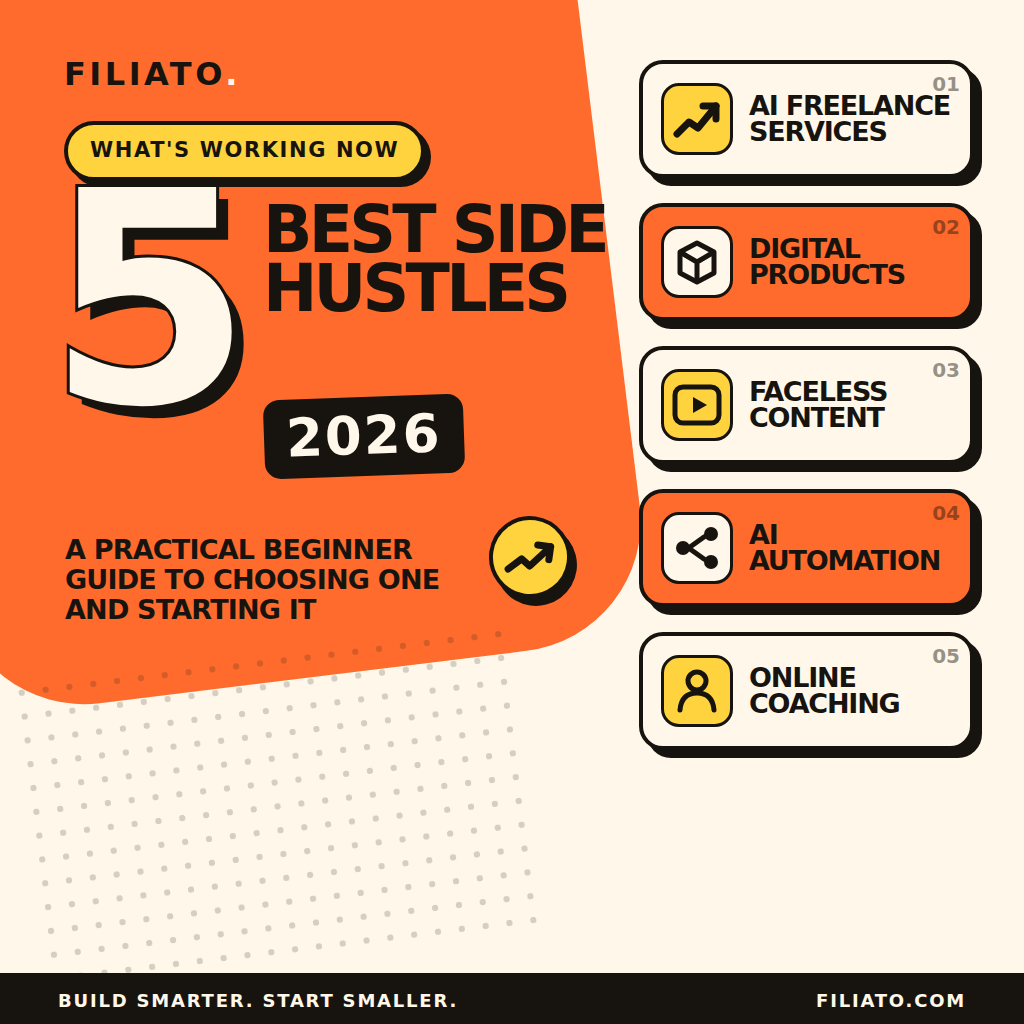
The best side hustles in 2026 at a glance
| Side hustle | Best for | Approximate starting cost | Speed to first income | Long-term potential |
|---|---|---|---|---|
| AI-assisted freelance services | People with an existing skill | $0 to $100 | Fast | High when packaged or specialised |
| Digital products | Creators who prefer building assets | Under $100 | Medium | High with a strong catalogue |
| Faceless content channels | Patient researchers and storytellers | $20 to $150 per month | Slow | High but unpredictable |
| AI automation services | Process-minded problem solvers | $0 to $100 | Medium | Very high recurring revenue potential |
| Online tutoring and coaching | People with knowledge to teach | $0 to $200 | Fast | Medium to high |
These figures are starting ranges, not promises. Your results will depend on your skills, market, offer, consistency and ability to reach the right customers.
1. AI-assisted freelance services
What this side hustle is
AI-assisted freelancing means selling a real professional service while using AI to research, draft, organise, edit or deliver parts of the work more efficiently.
Possible services include:
- Short-form video editing for coaches or local businesses
- SEO content for a specific industry
- Social media content packages
- Presentation and sales-deck design
- Email newsletter management
- Product descriptions for online shops
- Podcast editing and repurposing
- Marketing research and competitor analysis
The important word is service. Clients do not care which prompt you used. They care whether the video attracts attention, the article brings qualified visitors or the email campaign generates sales.
This is one reason AI-assisted freelancing is one of the strongest side hustles to start in 2026. Upwork’s marketplace data shows especially fast growth in AI video, image work, chatbot development and AI integration. The opportunity is not to compete with AI on cheap generic output. It is to combine AI with taste, subject knowledge, communication and responsibility.
Who it is best for
This model is ideal if you already know how to write, design, edit video, manage social media, run ads, organise data or work inside a particular industry.
You do not need to be the best in the world. You need to solve one defined problem for one type of customer.
Compare these two offers:
I create content with AI.
I turn one weekly podcast from a business coach into five captioned short videos, five social posts and one email newsletter.
The second offer is easier to understand, price and buy.
How to start
- Choose one result you can deliver. Start with a skill you already understand. Avoid offering writing, design, video, SEO and automation at the same time.
- Choose one customer type. Examples include estate agents, SaaS companies, fitness coaches, restaurants or ecommerce brands.
- Create three relevant samples. If you have no clients, make realistic demonstration projects. Redesign a weak social post, edit a sample Reel or write a short landing page for a fictional brand.
- Package the service. Define the deliverables, turnaround time, revision limit and price. A fixed package feels safer to a new client than an open-ended hourly arrangement.
- Contact potential clients. Use LinkedIn, Upwork, Fiverr, industry communities and direct email. Personalise every message around a visible problem.
- Turn the first successful project into proof. Ask for a testimonial and permission to show the before-and-after result.
A simple offer you could launch
Offer: Short-Form Content Starter Package
- Four edited vertical videos
- Captions and basic visual branding
- Four platform-ready descriptions
- One revision per video
- Seven-day delivery
Your first version could be priced to reduce the buyer’s risk. Once you have proof and a repeatable process, move clients onto a monthly package rather than continuing with isolated jobs.
The biggest mistake to avoid
Do not deliver unedited AI output. Generic text and one-click designs are easy to replace. Your value comes from understanding the audience, checking facts, improving the idea and taking responsibility for the finished result.
Your first-week action plan
Choose one service and one customer group. Create two samples, write a one-paragraph offer and contact ten carefully selected prospects. Your goal is not to build an agency in seven days. Your goal is to start three real conversations.
2. Selling digital products
What this side hustle is
A digital product is a file or resource that customers can buy and receive online. You create it once, then sell the same core product more than once without manufacturing or shipping physical stock.
Popular examples include:
- Canva templates
- Notion systems
- Spreadsheet calculators
- Printable planners and trackers
- Wedding stationery
- Social media content packs
- Business checklists
- Ebooks and short practical guides
- Digital worksheets
- SVG files for crafters
This model is attractive because the cost of delivering an additional copy is close to zero. However, digital products are not automatically passive. Research, design, listing images, customer questions, updates and promotion still require work.
Why it remains relevant in 2026
Customers increasingly pay for speed and organisation. They may be able to make a budget spreadsheet or content calendar themselves, but many would rather buy a polished system and use it immediately.
Etsy remains useful because it offers access to an existing marketplace. The company reported approximately 86.5 million active buyers at the end of 2025. Its current fee policy includes a $0.20 listing fee and a 6.5% transaction fee, in addition to payment processing and possible advertising fees.
Gumroad, Payhip and your own website can provide more control, but they usually require you to bring more of the traffic yourself.
Who it is best for
Digital products suit people who enjoy turning information into something structured and useful. You may already have valuable product ideas hidden inside your daily work.
For example:
- A recruiter can create an interview preparation workbook.
- A wedding photographer can sell a wedding-day timeline template.
- A freelancer can sell a client-onboarding system.
- A personal trainer can build a habit and progress tracker.
- A property manager can make a tenant inspection checklist.
Specific products usually have a stronger reason to exist than generic ones. A planner for everyone competes with thousands of alternatives. A 90-day content planner for independent estate agents solves a clearer problem.
How to start
- Find a repeated problem. Search marketplaces, forums, Facebook groups and customer reviews. Look for questions people ask repeatedly.
- Define one buyer. Write down who the product is for, what problem it solves and what changes after they use it.
- Create the smallest useful version. Do not begin with a 100-page ebook. A focused checklist, template or calculator can be more useful and easier to validate.
- Make the result easy to understand. Include instructions, examples and a clean folder structure. Test every link and formula.
- Create strong preview images. Buyers cannot hold a digital product, so your visuals must show what is included and how it works.
- Write a search-friendly listing. Use the exact phrases a customer would type, but keep the title readable.
- Collect feedback and build related products. One validated product can become a bundle, premium version or full collection.
A product-validation method
Before spending two weeks building, write the product title and sales description first. Share the idea with ten people who match the target audience. Ask which part would be most useful, what is missing and whether they currently use an alternative.
Better still, create a simple preview and accept a small number of early orders. Interest is useful feedback. Payment is stronger proof.
The biggest mistake to avoid
Do not create what is easy for you and assume people want it. A beautiful template without a defined customer problem is decoration, not a business asset.
Your first-week action plan
Choose one narrow audience. Find 20 existing products or discussions related to one repeated problem. Note the common complaints, then build a small version that improves one weak point. Publish or pre-sell it before creating a large catalogue.
3. Faceless YouTube and short-form content channels
What this side hustle is
A faceless channel publishes videos without making the creator’s face the centre of the content. Formats include narrated explainers, screen recordings, animated stories, software tutorials, mini-documentaries, data-led videos and carefully edited compilations using properly licensed material.
AI can help with topic research, outlines, narration, subtitles, visual concepts and editing. It can shorten production time, but it cannot remove the need for a distinctive point of view.
Possible income streams include:
- YouTube advertising revenue
- Affiliate commissions
- Sponsorships
- Paid communities
- Digital products
- Services related to the channel’s topic
Why this model needs a warning label
Faceless content is often promoted as an automated passive-income machine. In reality, it is closer to building a small media company. You need topic selection, research, packaging, thumbnails, editing, publishing and performance analysis.
YouTube also clarified its monetisation rules in July 2025 by renaming its repetitious-content policy to inauthentic content. Repetitive or mass-produced content may not be eligible for monetisation. AI can be part of the production process, but the result still needs to be original and useful.
For full advertising revenue access, YouTube currently requires 1,000 subscribers and either 4,000 valid public watch hours or 10 million valid Shorts views within the relevant periods. Reaching the numbers does not guarantee acceptance because the channel is reviewed against YouTube’s policies.
YouTube also requires disclosure when realistic media has been meaningfully altered or synthetically generated. A disclosure alone does not reduce monetisation eligibility, according to the platform’s 2026 update on AI labels.
Who it is best for
This model suits people who enjoy research, storytelling and experimenting with formats. It is not the best choice if you urgently need income next month.
Good channel ideas sit at the intersection of:
- A topic you can research for a long time
- A repeatable video format
- A clear audience
- More than one possible revenue stream
For example, a channel explaining useful software for freelancers could eventually earn from ads, software affiliate programmes, sponsorships and its own templates or guides.
How to start
- Choose one narrow promise. Instead of general business news, consider five-minute breakdowns of practical software for solopreneurs.
- Study successful formats. Analyse titles, thumbnails, opening hooks, video length and comment sections. Learn the structure without copying the content.
- Plan ten related videos. A good niche should produce more than one exciting idea.
- Create a repeatable workflow. Research, outline, script, record narration, collect licensed visuals, edit, check and publish.
- Make the first 30 seconds earn attention. State the problem and show the benefit quickly.
- Use analytics to improve one variable at a time. A weak click-through rate points to the title or thumbnail. Poor early retention points to the hook or pacing.
- Add a relevant income path early. A small affiliate offer or useful digital resource can generate revenue before advertising does.
The biggest mistake to avoid
Do not mass-produce near-identical videos from AI scripts, stock footage and synthetic voices. That approach creates weak content and increases monetisation risk. Use AI to support original research and presentation, not to avoid them.
Your first-week action plan
Select one topic, define one repeatable format and write ten titles. Produce one complete pilot video. Show it to five people in the target audience and ask where their attention dropped or what remained unclear.
4. AI automation services for small businesses
What this side hustle is
AI automation services help businesses remove repetitive manual work. You connect the tools they already use and build a workflow that moves information or triggers actions automatically.
Examples include:
- Sending an immediate response when a new lead completes a form
- Adding enquiries to a CRM and assigning a follow-up task
- Turning meeting notes into actions and a client email
- Categorising support requests before they reach a team member
- Sending appointment reminders
- Creating a weekly performance report from several data sources
- Moving approved content into a publishing calendar
Tools such as Make, Zapier and n8n allow many workflows to be created with little or no traditional coding. AI can classify text, extract information, summarise documents or draft a response inside the process.
Why it is one of the strongest 2026 opportunities
Many small businesses know that automation could save time, but they do not know which process to automate or how to make several tools work together. That creates room for a specialist who can understand the process, build the system and maintain it.
The business model can also include recurring revenue. A client may pay an initial setup fee, followed by a monthly amount for monitoring, maintenance and improvements.
The opportunity is supported by Upwork’s 2026 data, which found a 178% year-over-year increase in demand for AI integration skills. This is marketplace-specific data, not a guarantee that every automation offer will sell. It does show that businesses are paying for implementation, not simply discussing AI.
Who it is best for
This side hustle suits logical thinkers who enjoy mapping processes and fixing inefficiency. You do not need to be an advanced developer, but you must be comfortable with testing, permissions, data handling and troubleshooting.
Industry knowledge is a major advantage. If you understand how a dental clinic, estate agency, gym or marketing agency works, you can identify expensive friction faster than a general automation freelancer.
How to start
- Choose one industry. Start where you understand the language, customers and daily workflow.
- Interview business owners. Ask which repeated task wastes the most time, where leads get lost and which information is copied between systems.
- Choose one low-risk process. Lead notifications or internal reporting are safer first projects than an autonomous system that sends sensitive messages without review.
- Build a demonstration. Use dummy data and show the before-and-after workflow.
- Sell the outcome. “Respond to every website lead within two minutes” is stronger than “I build a Make scenario.”
- Set boundaries. Define what is included, who owns each account, how errors are reported and which steps require human approval.
- Offer ongoing monitoring. Automations can fail when an app, API or business process changes. Maintenance is part of the service, not an afterthought.
A simple offer you could launch
Offer: Local Business Lead Follow-Up System
When a potential customer completes the website form, the system validates the submission, adds it to the CRM, alerts the correct employee and prepares a personalised follow-up message. A human approves the message before it is sent.
This offer is easy to demonstrate and connects directly to a costly problem: missed leads.
The biggest mistake to avoid
Do not automate a broken process. If the client cannot explain what should happen, adding more tools may create faster confusion. Map the process first, simplify it, then automate the stable parts.
You also need to treat customer data carefully. Use the minimum information required, control access and never promise that a workflow will run forever without supervision.
Your first-week action plan
Talk to three business owners in one industry. Ask them to describe a repetitive task from beginning to end. Choose the clearest problem and build a short demonstration with dummy information. Use the demo to start conversations with ten similar businesses.
5. Online tutoring and coaching with AI support
What this side hustle is
Online tutoring means teaching an academic subject, language or professional skill through video calls or a learning platform. Coaching focuses more on applying knowledge, building habits and creating accountability.
AI can help a tutor prepare exercises, adjust material to a student’s level, create quizzes and summarise progress. The human tutor remains responsible for accuracy, explanation, motivation and feedback.
Strong niches include:
- Mathematics and science
- Coding and data skills
- Test preparation
- Business English
- Presentation and interview practice
- Software training
- AI literacy for professionals
- Career or portfolio coaching in a field where you have proven experience
Why it remains attractive
This is one of the fastest ways to turn existing knowledge into side income. You do not have to build an audience or wait for a catalogue of products to rank. You need a clear subject, a credible profile and a way to reach suitable students.
Platforms such as Preply, Wyzant, Superprof, Cambly and Outschool can help with discovery. Their costs and rules vary. For example, Preply currently takes 100% of the tutor’s first trial lesson with a new student, then 18% to 33% of later lessons, depending on completed teaching hours. Always calculate what you keep after platform fees before setting your rate.
Who it is best for
Tutoring is a natural fit if colleagues already ask you to explain things. Formal credentials can help in some subjects, but clarity, patience and demonstrable results matter greatly.
Do not describe the offer too broadly. “English lessons” competes with thousands of profiles. “Business English interview preparation for software engineers” speaks to a specific outcome.
How to start
- Choose a subject you can teach confidently. Stay within your competence and avoid areas where incorrect guidance could cause serious harm.
- Define the student and outcome. Examples include passing an exam, improving workplace communication or completing a first portfolio project.
- Create a simple learning path. Map the starting assessment, weekly topics, practice tasks and progress checks.
- Choose a platform or sell independently. Platforms make discovery easier but take a percentage. Independent tutoring gives you more control but requires marketing and payment systems.
- Prepare one strong introductory lesson. The student should leave with a useful result and a clear understanding of what comes next.
- Ask for specific feedback. Results and testimonials make it easier to increase your price.
- Scale carefully. Move from one-to-one sessions into small groups, workshops, recorded material or downloadable resources.
A simple offer you could launch
Offer: Four-Week AI Productivity Coaching for Freelancers
- Week 1: Identify repetitive work and choose suitable tools
- Week 2: Build a safe research and drafting workflow
- Week 3: Create reusable prompts and quality checks
- Week 4: Measure time saved and improve the process
This is more compelling than generic AI coaching because it has a defined customer, timeline and outcome.
The biggest mistake to avoid
Do not compete only on price. A low hourly rate may attract unreliable students and leave little room for preparation. Compete on relevance, structure and results.
Your first-week action plan
Choose one audience and one outcome. Create a four-session plan, record a short profile video and invite three suitable people to a discounted pilot. Use their questions and feedback to improve the programme.
Which side hustle should you choose?
The best option depends less on what is popular and more on what you can realistically sustain.
Choose AI-assisted freelance services if you already have a useful skill and want the shortest route to a paying customer.
Choose digital products if you enjoy creating structured resources and can wait while a catalogue and traffic source develop.
Choose faceless content if you enjoy research and publishing, can tolerate uncertain results and are willing to build for at least six to twelve months.
Choose AI automation services if you understand processes, like solving business problems and want the potential for monthly retainers.
Choose online tutoring or coaching if you can explain a valuable subject and prefer direct work with people.
If you need immediate cash and none of these models matches your current skills, reselling unwanted or underpriced items can be a useful temporary option. It is less scalable, but it can create starting capital while you develop a more specialised offer.
A realistic 30-day plan to start your side hustle
Reading about five ideas can easily become another form of procrastination. Use this plan to test one idea before the month ends.
Days 1 to 3: Choose one problem
Write down your current skills, industry knowledge, tools, interests and access to potential customers. Select one hustle and one audience. Do not build five projects at once.
Complete this sentence:
I help [specific person] achieve [specific result] through [service, product or method].
Days 4 to 7: Research real demand
Find at least 20 examples of the problem. Use marketplace listings, job posts, reviews, forums, search suggestions and conversations with potential customers.
Look for repeated language. The words customers use should influence your offer, content and SEO.
Days 8 to 14: Build the smallest useful version
Create one service package, one digital product, one pilot video, one automation demonstration or one lesson plan. It should be good enough to show and test, not large enough to hide behind for a month.
Days 15 to 21: Put it in front of people
Contact prospects, publish the listing, upload the video or invite pilot students. Track replies and questions. Silence is also information. It may mean the audience, promise or distribution method needs to change.
Days 22 to 30: Improve based on evidence
Review what happened:
- Did people understand the offer?
- Did the right people show interest?
- Which question appeared repeatedly?
- Did anyone pay, book or ask for the next step?
- How much time did delivery require?
Improve one part and run the test again. Do not abandon the entire model because the first version was weak.
How to recognise a side-hustle scam
The growing interest in AI and online business has also created more misleading offers. The US Federal Trade Commission launched Operation AI Comply against several schemes that used AI claims or promised large returns from online businesses.
Be cautious when an offer includes:
- Guaranteed income
- Large returns with little effort
- Pressure to pay immediately
- Expensive upsells before you understand the business
- Income screenshots without verifiable context
- A system that depends mainly on recruiting more buyers
- No clear explanation of who the end customer is or why they would pay
A real business opportunity should still make sense without the hype. You should be able to explain the customer, problem, offer, delivery method and route to profit.
Frequently asked questions
What is the best side hustle to start in 2026?
For most people with an existing professional skill, AI-assisted freelancing offers the fastest route to validation and income. The best long-term choice may be digital products or automation services because they can become less dependent on your individual hours. Your experience and access to customers matter more than a universal ranking.
What side hustle can I start with no money?
Freelancing, tutoring and simple automation demonstrations can be started with free tools if you already own a computer and have internet access. Start with a service based on a skill you possess, then reinvest the first income into better tools or training.
Are AI side hustles really profitable?
AI can make a useful service or product faster to produce, but AI alone does not create demand. Profit comes from solving a valuable problem, reaching customers and delivering quality consistently. Avoid any programme that guarantees earnings simply for using a particular tool.
Can faceless YouTube channels still be monetised?
Yes, provided the channel meets YouTube’s eligibility requirements and its content is original, authentic and policy-compliant. Low-effort, repetitive or mass-produced content may be rejected. AI can assist the workflow, but it should not replace original research, creative decisions and quality control.
How long should I test a side hustle before changing direction?
Give a well-defined offer enough time to reach real potential customers. Thirty days is enough for an initial test, while 90 days of consistent outreach or publishing provides stronger evidence. If nobody shows interest, change the audience, promise or offer before abandoning the entire business model.
Final thoughts
The biggest side-hustle trend in 2026 is not a single platform or tool. It is the combination of human expertise, faster production and direct access to customers.
Start with what you already know. Choose one problem. Create the smallest useful offer. Put it in front of real people and improve it from their response.
You do not need five side hustles. You need one model that fits your skills, schedule and patience well enough to continue after the initial excitement disappears.
If you want to discuss your idea, ask questions and meet other people building online businesses, join the Filiato community. You can also explore more practical business resources and free guides on Filiato.